
Huapai Clinic Huapai Clinic 338 Main Road, Huapai 0810 | Henderson Satellite Clinic Henderson Satellite Clinic Shop 123, WestCity, 7 Catherine Street, Henderson 0612

09 412 77 40 027 740 45 45Huapai Clinic Huapai Clinic 338 Main Road, Huapai 0810 | Henderson Satellite Clinic Henderson Satellite Clinic Shop 123, WestCity, 7 Catherine Street, Henderson 0612
Overview: Ingrown toenails can go from mildly annoying to seriously painful fast, especially once infection sets in. The good news: most cases clear up with simple podiatry care, and for nails that keep coming back, a quick in-clinic procedure can fix it for good. This guide covers what causes ingrown toenails, how to spot infection early, and the full range of treatment options, from conservative care to minor surgery and recovery.
An ingrown toenail happens when the edge of the nail grows into the surrounding skin, causing pain, redness, and sometimes infection.
Ingrown toenail treatment ranges from simple conservative care for mild cases to a short in-clinic procedure for nails that keep coming back.
Knowing which category your toenail falls into determines how quickly it clears up and whether it’s likely to come back once it’s healed.
Ingrown toenail treatment starts with understanding why the nail grew inward in the first place, since the cause often shapes the right approach.
Options range from simple conservative care through to minor surgery, and ingrown toenail treatment and surgery in West Auckland cover the full range depending on severity.
A naturally curved or pincer-shaped nail is more likely to dig into the surrounding skin as it grows, regardless of footwear or trimming habits.
Cutting nails too short or rounding the corners instead of trimming straight across encourages the edge to grow into the skin as it lengthens.
Tight, narrow, or pointed footwear applies constant pressure to the nail fold throughout the day, which can make an existing curve or trimming issue considerably worse over time.
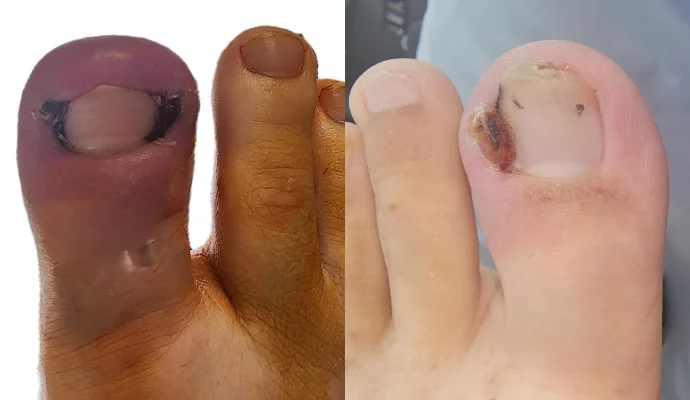
Ingrown toenail infection symptoms typically include redness, swelling, warmth around the nail fold, and pain that worsens with pressure or contact.
Yellow or white discharge, a noticeable odour, or skin around the nail that looks shiny and tight can indicate infection and are reasons to have the toe assessed promptly.
Mild to moderate cases often respond well to conservative care, where a podiatrist trims and carefully lifts the ingrown edge away from the skin.
This is usually done without injections, and many patients feel meaningful relief the same day.
The problem can return if the underlying cause, such as trimming technique or footwear, isn’t addressed, which is why recurring cases are often reviewed for a longer-term option instead.
When conservative care doesn’t work, or the nail continues to cause problems, a minor surgical option is usually the next step to consider.
Podiatrist toenail surgery in Auckland generally falls into one of two categories, depending on how much of the nail is genuinely affected.
Partial nail avulsion (PNA) in NZ removes only the ingrown section of the nail under local anaesthetic, so the toe is numb throughout the short procedure.
A chemical, most often phenol, is then applied to the exposed nail matrix to prevent that section from regrowing, providing a long-term or permanent solution in most cases.
The procedure generally takes around 45-90 minutes depending on how many nail edges are being treated, and patients are able to walk out afterwards.
Total Nail Avulsion (TNA) may be recommended when the entire nail is significantly damaged, thickened, infected, or repeatedly causing problems. This involves removing the full nail under local anaesthetic. Depending on the individual situation, the nail may be allowed to regrow, or a chemical may be applied to prevent regrowth.
Most patients walk comfortably the same day or the next, with full healing generally taking around two to four weeks.
Some clear discharge or oozing in the first few weeks is normal after the chemical treatment and isn’t a sign that something has gone wrong.
Keeping the area clean and dry, changing dressings as advised, and wearing roomier footwear during recovery all support a smoother, faster healing process.
Trimming nails straight across, rather than rounding the corners, is one of the simplest ways to reduce the risk of a nail growing inward.
Conservative toenail care in West Auckland clinics often includes footwear advice, since shoes that squeeze the toes are a common contributor to recurring problems.
For nails that keep curving inward despite good trimming habits, a nail-bracing option can gradually retrain the direction of growth without surgery.
The procedure itself is performed under local anaesthesia, so pain during the surgery is minimal to none. Most people walk comfortably within a day, with full healing generally taking two to four weeks, depending on the individual.
Very mild irritation may settle with reduced pressure on the toe, roomy footwear, and keeping the area clean. Avoid cutting deeply down the sides of the nail or trying to remove the ingrown section yourself. If pain persists, the nail keeps recurring, or there is redness, swelling, or discharge, it is best to have it assessed by a Podiatrist.
Onyfix uses a composite brace applied to the nail's surface, which is cured under a light and gently guides new growth into a flatter shape. It's painless and non-surgical, making it a useful option for nails that keep curving inward despite careful trimming habits.
Tight, narrow, or pointed shoes put constant pressure on the nail fold and are a common contributor to ingrown nails. Roomier shoes with enough space at the toe box reduce that pressure and support healthier nail growth over time.
Copyright ©2025 Norwest Podiatry All Rights Reserved.